
At first, the problem looks like a lack of information. You open more databases, download more PDFs, follow more citation trails, and build a reference list that looks impressive. But after a while, the opposite problem appears: there is too much literature. Every paper adds another method, another limitation, another debate, another “future research should…” sentence. You know the field better than you did last week, but you still cannot explain what your own study should contribute.
That is the real challenge behind learning how to find a gap in research. A research gap is not just an empty space where nobody has published anything. It is a specific unanswered, unresolved, under-tested, or poorly explained part of the existing literature. The best gaps are grounded in what researchers already know, but they also point clearly to what the field still needs to understand.
This guide walks through a practical workflow for finding research gaps without getting lost in endless reading. You will learn what a research gap actually is, where gaps usually appear, how to test whether a gap is worth pursuing, and how to turn a promising gap into a clear research question.
What Is a Research Gap?
A research gap is the distance between what the literature has already established and what it still cannot adequately explain.
Sometimes the gap is a missing population. Researchers may have studied an intervention among university students, but not among younger learners, older adults, or people in non-Western contexts. Sometimes the gap is methodological. A topic may rely heavily on survey data even though behavioral data, longitudinal data, experimental evidence, or qualitative interviews would answer a different kind of question. Sometimes the gap appears because results conflict. Several studies may examine the same relationship but reach different conclusions, leaving the field unsure why the evidence does not align.
A weak gap statement usually sounds like this:
There is little research on online learning motivation.
That may be true, but it is too broad to support a strong study. A better version would be:
Existing studies have examined online learning motivation mainly through short-term self-report surveys, but less is known about how motivation changes across a full semester when learners receive different types of AI-generated feedback.
The second version does more work. It identifies what has been studied, what remains unclear, and why the missing piece could become a researchable question.
A Research Gap Is Not Just “Nobody Has Studied This”
Many students assume novelty is enough. If they search a phrase and find only a few papers, they treat that absence as a gap. That can be risky.
A topic may look unexplored because researchers use different terminology. A question may have been answered in a neighboring field. A missing topic may be missing because it is not important, not measurable, or not feasible. In some cases, “nobody has studied this” means “nobody has found a strong reason to study this yet.”
A useful research gap usually connects three elements:
What the literature already knows → what it still does not explain → why that missing piece matters.
If you cannot explain all three, the idea probably needs more work before it becomes a defensible research gap.
How to Find a Gap in Research
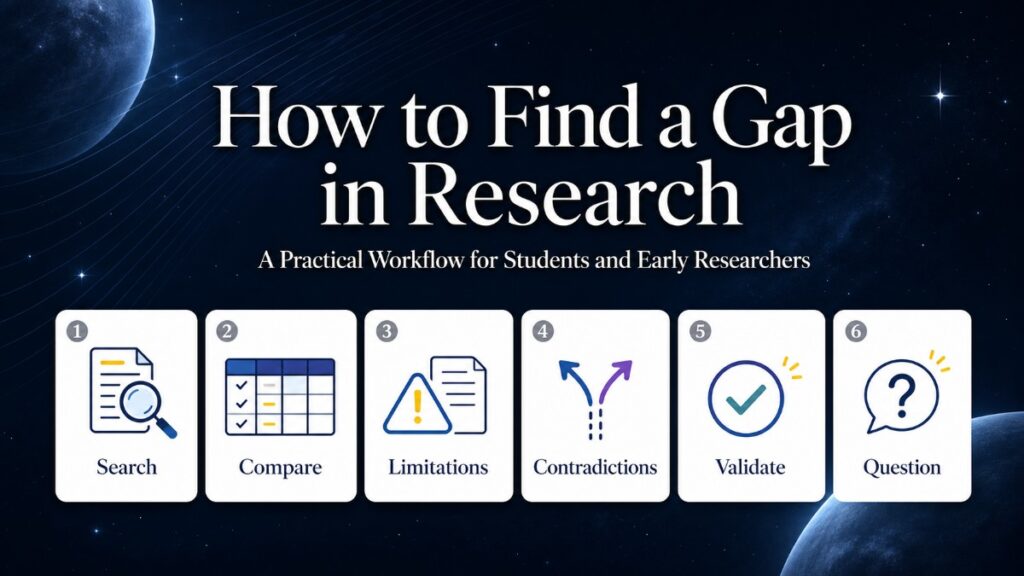
Finding a research gap works best when you treat the literature review as a comparison task, not a reading marathon. Your goal is not to summarize every paper one by one. Your goal is to understand how papers relate to each other: where they agree, where they disagree, what they repeatedly ignore, and what assumptions they leave untested.
1. Start With a Focused Research Area
Do not begin with the pressure of finding “the gap.” Begin with a focused area that gives your search boundaries.
A broad topic such as “AI in education” is too large. It can lead you into adaptive learning, automated grading, generative AI, teacher workload, student motivation, academic integrity, intelligent tutoring systems, and dozens of unrelated subtopics.
A more useful starting point would be:
How does AI-generated feedback affect revision quality in undergraduate writing courses?
This is still not the final research question, but it gives you a manageable search space. You know the population, the intervention, the outcome, and the educational context. That makes it easier to identify which papers matter and which papers are only loosely related.
A focused starting area also helps prevent a common mistake: confusing a broad theme with a research gap. “AI feedback in education” is a theme. “Limited evidence on how students use AI feedback across multiple revision cycles” is closer to a gap.
2. Search the Literature Using Multiple Terms
Once your area is focused, search beyond the first phrase that comes to mind. Academic fields often use overlapping vocabulary. What you call “AI feedback” might appear in papers as automated feedback, intelligent tutoring feedback, generative feedback, writing analytics, formative feedback systems, or computer-assisted writing support.
Start with recent review articles, systematic reviews, meta-analyses, and highly relevant empirical studies. Reviews help you learn the vocabulary of the field and identify the main debates. Primary studies help you see how researchers actually test the topic.
As you search, record more than titles and citations. Track the research question, population, method, data source, key finding, limitation, and future research suggestion for each paper. This turns your reading into a map rather than a pile of notes.
The goal at this stage is not to read everything. It is to understand the shape of the literature well enough to see patterns.

3. Compare Papers Side by Side
Research gaps often appear only when papers are compared.
If you read papers sequentially, each study may seem reasonable on its own. But when you put them next to each other, differences become visible. One study uses first-year students while another uses experienced professionals. One measures short-term attitudes while another measures long-term performance. One relies on self-reported behavior while another tracks actual behavior. One studies a tool in a controlled classroom while another studies it in an open online environment.
These differences are not just details. They may explain why results vary or why a conclusion remains uncertain.
When comparing papers, ask:
- What population did each study examine?
- What context or setting did it use?
- What method and data source did it rely on?
- What outcome did it measure?
- What did the study exclude?
- What limitation did the authors acknowledge?
- Do the findings agree, partly agree, or conflict?
A research gap often begins as a repeated pattern in this comparison table.
4. Look for Repeated Limitations and Future Research Signals
Limitations sections are useful, but they should not be copied blindly. A single author saying “future research should examine X” does not automatically make X a strong gap. The stronger signal appears when multiple papers point to the same unresolved issue.
For example, imagine ten studies on a learning intervention. Eight use small samples. Seven measure outcomes immediately after the intervention. Six rely on self-reported confidence rather than actual performance. Several authors mention that longer-term evidence is missing.
Now you are seeing a pattern. The gap is not simply “more research is needed.” The gap may be that the field lacks longitudinal evidence on whether the intervention improves real performance over time.
Repeated limitations are especially valuable because they show that the missing piece is not random. It has been noticed by multiple researchers and still remains insufficiently addressed.
5. Investigate Contradictions in the Literature
Contradictory findings can be one of the strongest sources of research gaps.
If one study finds that X improves Y and another finds no effect, the gap may not be whether X has been studied. It may be why the evidence differs. Did the studies use different samples? Did they measure different outcomes? Did one study last two weeks while another lasted six months? Did the effect depend on context, dosage, prior knowledge, age, technology access, culture, or implementation quality?
A contradiction becomes useful when you can turn it into an explanatory question:
Why do studies on X produce different outcomes across contexts?
or:
Under what conditions does X affect Y?
This type of gap is often more valuable than a completely untouched topic because it begins from an active debate in the literature.
6. Check Whether the Gap Is Still Open
This step is easy to skip and costly to ignore.
A paper published several years ago may identify a limitation that sounds perfect for your thesis. But newer studies may have already addressed it. Before building your project around a gap, search forward. Check papers that cite the original study. Search the proposed gap using alternative terms. Look for recent reviews. Search by method, population, and outcome, not only by topic.
A valid research gap must describe what the field still does not adequately know now, not what it did not know at the time one older paper was published.
This is also where AI tools can help with first-pass literature scanning, but verification remains essential. Do not let an AI-generated suggestion become your gap until you have checked the underlying studies yourself.
Where Research Gaps Usually Hide
Most research gaps fall into recognizable patterns. Once you know these patterns, literature review becomes less overwhelming because you know what signals to look for.
Population or Context Gaps
A finding may be well established in one group but untested in another. For example, a theory may be supported in studies of undergraduate students but rarely tested among working adults. A public health intervention may be evaluated in urban hospitals but not in rural clinics. A technology may perform well in English-language datasets but remain under-examined in multilingual or low-resource settings.
The key is not simply that another population exists. The question is whether the missing population or context could meaningfully change the findings.
Methodological Gaps
Sometimes the topic has been studied often, but the methods are limited. A field may rely heavily on cross-sectional surveys, small samples, laboratory experiments, short follow-up periods, or narrow datasets. If those methods cannot answer an important question, the limitation may become a gap.
For example, if most studies measure student confidence immediately after using a learning tool, there may still be a gap around long-term learning outcomes, behavioral engagement, or transfer to real assignments.
Evidence Gaps
An evidence gap appears when the literature contains claims, theories, or assumptions that have not been tested strongly enough. Researchers may believe a mechanism explains an outcome, but few studies directly examine that mechanism. A practice may be widely recommended even though the supporting evidence is thin.
This type of gap is useful when you can specify what kind of evidence is missing and how a study could produce it.
Theoretical Gaps
A theoretical gap appears when existing theories do not fully explain a phenomenon, especially in a new context. For example, a theory developed for face-to-face learning may not explain student behavior in AI-supported learning environments. A model built around individual decision-making may fail to explain collaborative or community-based behavior.
Theoretical gaps are powerful, but they require careful framing. You need to show what the theory explains, where it falls short, and why extending or revising it matters.
Practical or Application Gaps
Some gaps appear between research and real-world use. Researchers may know that an intervention works in controlled conditions, but practitioners may not know how to implement it at scale. A tool may perform well in benchmarks but poorly in messy real-world settings. A policy may be supported in principle but under-tested in actual institutions.
This kind of gap is especially relevant for applied fields, where the contribution may involve implementation, usability, adoption, or outcomes in practice.

How to Know If You Have Found a Good Research Gap
A possible gap is not automatically a good gap. Before you commit to it, pressure-test the idea.
Is the Gap Specific?
A strong gap should be narrow enough that another researcher can understand exactly what is missing. “More research on climate change” is not specific. “Limited longitudinal evidence on how repeated freeze-thaw cycles affect soil carbon release in permafrost regions” is specific.
If your gap statement could apply to hundreds of unrelated studies, it is probably too broad.
Is the Gap Supported by Evidence?
You should be able to point to the papers that establish what is known and the papers that reveal what remains unclear. A gap is not just your personal curiosity. It must be anchored in the literature.
A useful test is to write the gap in one sentence:
Existing research shows ___, but it remains unclear ___ because most studies ___.
If you cannot fill in the blanks with evidence from actual papers, keep reviewing.
Is the Gap Meaningful?
Ask the uncomfortable question: so what?
If your study answered this gap, what would change? Would it resolve a debate, improve a method, extend a theory, clarify a mechanism, inform practice, or help future researchers design better studies?
A gap can be real and still not worth pursuing. The contribution needs to matter.
Is the Gap Feasible?
A research gap may be important but unrealistic for your project. A ten-year longitudinal study may be valuable, but not feasible for a semester paper or master’s dissertation. A dataset may be ideal but inaccessible. A method may be impressive but beyond your training or resources.
The best research gap sits at the intersection of significance and feasibility. It is meaningful enough to justify the work and focused enough that you can realistically investigate it.

How to Turn a Research Gap Into a Research Question
Once you identify a promising gap, the next step is to convert it into a research question. This transition matters because a gap explains why research is needed, while a research question explains what your study will investigate.
Start with the known evidence:
Existing studies suggest that AI-generated feedback can improve students’ revision awareness.
Then identify what remains unclear:
However, most studies examine short-term perceptions rather than changes in actual revision behavior over multiple assignments.
Then turn the gap into a question:
How does repeated exposure to AI-generated feedback influence undergraduate students’ revision behavior across a semester-long writing course?
This question is stronger than “How does AI feedback affect students?” because it defines the intervention, population, outcome, and timeframe.
A good research question should grow naturally from the gap. If the connection feels forced, return to the literature and refine the gap statement.
How AI Can Help You Find a Research Gap
AI can make research gap analysis faster, especially when you are comparing many papers. The value is not that AI magically decides what you should study. The value is that it can help organize evidence, summarize patterns, compare methods, and surface possible gaps for human review.
A good AI workflow might look like this:
1. Upload or summarize a focused set of papers.
2. Ask the tool to extract each paper’s research question, method, sample, finding, limitation, and future research suggestion.
3. Compare the extracted information across papers.
4. Identify repeated limitations, contradictions, missing contexts, and under-tested assumptions.
5. Verify every promising gap by returning to the original literature.
The last step is non-negotiable. AI can hallucinate, overstate novelty, or miss papers that use different terminology. Treat AI as a research assistant for organizing and comparing literature, not as the final authority on originality.
If you use a Research Gap Finder, give it a specific task. Instead of asking, “Give me research gaps about online learning,” ask:
Compare recent studies on AI-generated feedback in undergraduate writing courses. Identify recurring limitations, conflicting findings, missing populations, and unanswered questions. For each possible gap, explain which evidence supports it and what still needs to be verified.
That prompt leads to better output because it keeps the tool tied to evidence.
Common Mistakes When Finding Research Gaps
One common mistake is choosing a gap too early. Students often fall in love with the first interesting limitation they find. Then they build a proposal before checking whether the issue is still open or whether the gap is feasible.
Another mistake is relying too much on “future research” sentences. These sections are helpful, but they are not proof. Authors may suggest future work broadly, briefly, or speculatively. You still need to examine whether other researchers have already addressed the suggestion.
A third mistake is confusing personal interest with academic contribution. It is fine to begin with curiosity, but a research gap must be justified through literature. The reader should understand why the field needs this study, not only why you find the topic interesting.
Finally, many researchers write gap statements that are too vague. Phrases such as “limited research exists,” “few studies have explored,” and “more research is needed” are only starting points. Stronger writing explains what is limited, where the evidence stops, and why the missing evidence matters.
FAQs About Finding Research Gaps
How many papers should I read before identifying a research gap?
There is no fixed number. Start with recent reviews and key studies, then expand until you understand the main findings, methods, debates, and limitations in your area. The goal is not to hit a paper count. The goal is to reach enough coverage to recognize what is established and what remains unresolved.
Can a contradiction between studies be a research gap?
Yes. Contradictory findings can be a strong research gap if the disagreement is meaningful and still unexplained. The research question often becomes less about which study is “right” and more about what conditions, methods, populations, or contexts explain the difference.
What is the difference between a research gap and a research question?
A research gap describes what the literature does not adequately explain. A research question turns that missing piece into something your study can investigate. The gap gives the reason for the study; the research question defines the study’s focus.
How do I know if my research gap is original?
Search recent studies, citation trails, systematic reviews, and alternative terminology. Check whether newer work has addressed the issue. Originality does not always mean nobody has touched the topic. It often means you are examining a specific unresolved aspect in a clearer, better-supported, or more feasible way.
Can AI reliably find research gaps?
AI can help with literature comparison, pattern detection, and first-pass research gap analysis. However, it should not be treated as proof that a gap exists. Always verify AI-generated suggestions against the original papers and recent literature.
Find Research Gaps With TutorGPT
Finding a research gap becomes easier when you stop reading papers as isolated documents and start comparing them as evidence. TutorGPT can help with that workflow by organizing literature around your topic, extracting key details from papers, and highlighting possible patterns across findings, methods, limitations, populations, and contexts.
Use TutorGPT to move from scattered reading to structured research gap analysis. Start with a focused topic or question, compare the relevant literature, review the potential gaps, and then verify the strongest ideas against the original sources.
The goal is not to let AI choose your research direction for you. The goal is to make the difficult middle stage—finding, comparing, and connecting evidence—less overwhelming, so you can make a stronger academic decision with more confidence.