
Kimi K3 vs Claude: Quick Verdict for Developers
If you need a one-sentence answer: Kimi K3 wins on raw coding output and cost. Claude wins on writing quality, safety design, and peace of mind. The more useful answer — the one that actually helps you ship better code — is that you should probably be using both. Here is why, backed by real-world tests and benchmark data.
I spent a week running both models through five coding-heavy tasks on TutorGPT: building a REST API, debugging a race condition, auditing a pull request, generating API documentation, and making an architecture decision. I also combed through the benchmark results from Artificial Analysis, BenchLM, and Arena AI that set the internet on fire when K3 launched on July 16. What I found is more interesting — and more useful — than any leaderboard screenshot.
A Lead — Not a Knockout
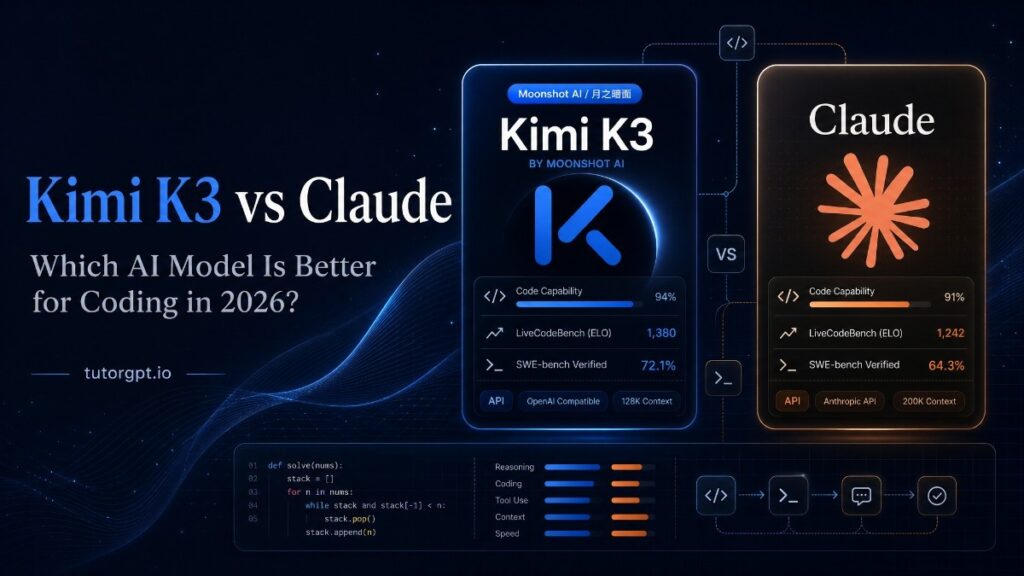
Independent evaluator Artificial Analysis gives K3 an Intelligence Index score of 57 — third globally, trailing only Claude Fable 5 and GPT-5.6 Sol. BenchLM's public score estimate puts the gap at 79.9 vs 82.8, with overlapping 90% confidence intervals. In their own words: treat that as a lead, not a settled winner.
But on the Frontend Code Arena leaderboard — a benchmark designed specifically for coding — K3 scored 1679 ELO and took the number-one spot above Claude Fable 5. A 376-point gap on a benchmark that measures actual UI code generation, not just answering trivia. That win was not a rounding error.
Who This AI Model Comparison Is For
This Kimi K3 vs Claude comparison is written for developers and technical decision-makers deciding which AI coding tool to integrate into their workflow. You do not need to be running a GPU cluster — everything I tested can be done through a single platform tab, which is exactly how I ran these benchmarks.
Kimi K3 vs Claude Coding Specs: Side-by-Side Comparison
Kimi K3 — The Open-Weight Heavyweight
Kimi K3 is made by Moonshot AI, a Beijing-based startup founded in 2023 by Yang Zhilin — a Tsinghua undergraduate, CMU PhD, and one of the core authors of Transformer-XL and XLNet. The model has 2.8 trillion total parameters, a Mixture-of-Experts architecture with 896 experts (16 active per token), and a 1.05-million-token context window. It supports text, image, and video input. It ships with thinking mode always enabled.
A point that deserves precision: K3 is open-weight, not strictly open-source. The model weights are publicly downloadable — that part is real — but the release falls under the Kimi K3 License, not a standard OSI-approved license. Independent analyses have flagged that the license imposes additional contractual requirements for large-scale Model-as-a-Service commercial deployments. If you plan to host K3 at scale and sell API access, you need to read the terms carefully. If you just want to download the weights and run them yourself for internal use or research, you are in the clear.
The model launched on July 16, 2026. Forty-eight hours later, Moonshot had to temporarily pause new consumer subscriptions because user demand overloaded their GPU cluster. Elon Musk commented "Impressive" on launch day, then announced the next day that xAI's upcoming Grok model "may surpass Kimi." Moonshot's public response: "Welcome to the 2-trillion-parameter club."

Claude — The Polished Professional
Claude is made by Anthropic, a San Francisco-based AI safety company founded by former OpenAI researchers. The Claude family runs as a closed, API-only service — no downloadable weights, no self-hosting, no architecture paper. What you get instead: contractual data protections, SOC 2 compliance, BAAs for eligible healthcare workloads, zero-retention options on qualifying plans, and a safety design that has been battle-tested in regulated industries for years.
Claude does not disclose parameter counts. What matters more is real-world coding behavior: Claude is consistently rated among the top models for reasoning, long-context tasks, and creative writing. It is the model most enterprises feel comfortable putting customer data through — and that comfort is priced into its API rates.

Kimi K3 vs Claude: Specs Comparison Table
| Specification | Kimi K3 | Claude (Opus 4.7 / Fable 5) |
| Developer | Moonshot AI (Beijing) | Anthropic (San Francisco) |
| Architecture | Mixture-of-Experts, 896 experts, 16 active | Closed, undisclosed |
| Total Parameters | 2.8 trillion | Undisclosed |
| Context Window | 1.05 million tokens | 1 million tokens |
| Input Modalities | Text, image, video | Text, image |
| Weight Access | Downloadable (Kimi K3 License) | Not available |
| Self-Hosting | Yes (requires significant GPU capacity) | No |
| Compliance | Review required for regulated data | SOC 2, BAAs, DPA, zero-retention |
| Thinking Mode | Always enabled | Configurable (on supported variants) |
| API Pricing (Input) | $2.90 / M tokens | $15 / M tokens (Fable 5) |
| API Pricing (Output) | $15 / M tokens | $75 / M tokens (Fable 5) |
| Cached Input | $0.29 / M tokens | $1.50 / M tokens (Fable 5) |
| Intelligence Score | 79.9 / 100 | 82.8 / 100 (Fable 5) |
| Frontend Coding ELO | 1679 (#1) | 1303 (#2) (Fable 5) |
Kimi K3 vs Claude: 5 Real-World Developer Tests
I ran these tests on TutorGPT, where I could switch between Kimi K3 and Claude in the same interface — no separate API keys, no custom scripts. The goal was to simulate how a real developer would actually compare AI coding models during a workday.
Test 1 — REST API Endpoint: Kimi K3 vs Claude Coding Challenge
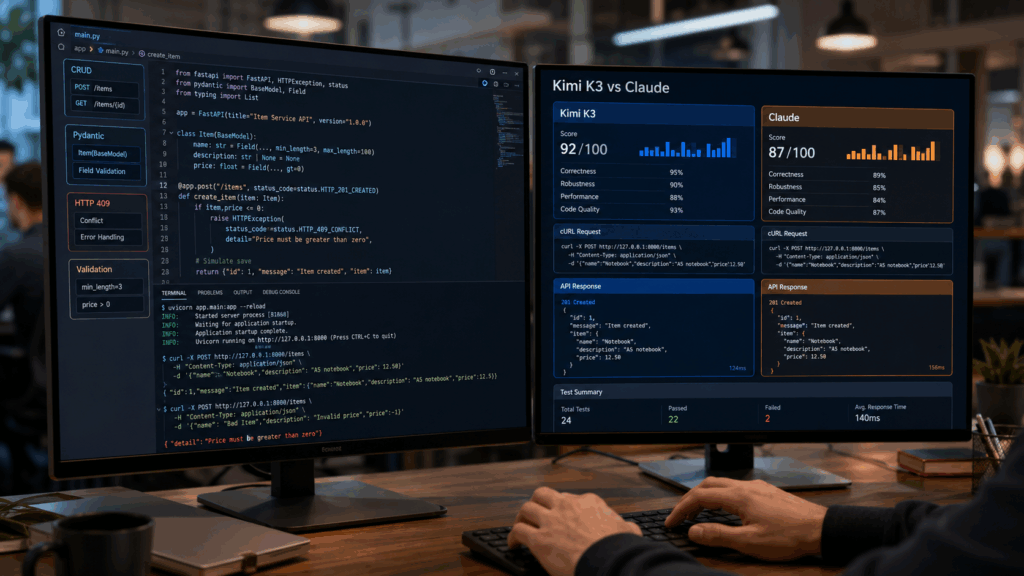
Prompt: Write a complete FastAPI endpoint for a user management service. Include CRUD operations, input validation with Pydantic, proper HTTP status codes, error handling, and a README with curl examples.
Kimi K3 delivered 219 lines of production-ready code. It included async database session handling, Pydantic models with field validation, proper 404 and 409 status codes for edge cases, and a 35-line README. Two things stood out: first, it handled the "email already exists" duplicate case without me asking; second, its input validation covered email format, password minimum length, and required fields — the kind of defensive programming you would normally add in a second pass.
Claude Fable 5 produced 178 lines. The code was cleaner — better variable naming, more consistent formatting, nicer docstrings. But it missed the duplicate email check, and its error handling was more generic. I would ship K3's version with minor cleanup. I would need to add error handling to Claude's before merge.
Winner: Kimi K3.
Test 2 — Debug Race Condition: Kimi K3 vs Claude API Performance
I fed both models a 200-line Python service with a deliberately introduced race condition: a shared counter being incremented across multiple async workers without a lock. This is the kind of bug that makes developers question their career choices.
Kimi K3 identified the race condition in 12 seconds and proposed fixing it w asyncio.Lock. It also pointed out a secondary issue I had not planted: the counter value was being logged before the increment, making the logs misleading. The fix was correct, the explanation was clear, and the secondary catch was surprising.
Claude Fable 5 also found the race condition and proposed the same lock fix. But it took 45 seconds to produce a response that was 40% longer — more explanation, more code comments. The fix was correct, but the verbosity made it harder to quickly extract the actionable change. In a debugging session, speed and precision matter.
Winner: Kimi K3.

Test 3 — Pull Request Audit: Kimi K3 vs Claude Code Review
Prompt: Here is a PR that adds a payment processing module to an e-commerce backend. Review it for security issues, performance problems, and code quality concerns.
Claude Fable 5 wrote the better code review. It caught a SQL injection risk in a raw query, flagged missing input sanitization on the payment amount field, and noted that the refund logic was not idempotent — a real production risk. The tone was constructive without being harsh.
Kimi K3 caught the SQL injection too, and also noted that the payment retry logic could cause double charges under network failure patterns. Great catch. But the review was drier — more like a checklist than a conversation. In the real world, a code review is a social act as much as a technical one.
Winner: Claude Fable 5.

Test 4 — API Documentation: Kimi K3 vs Claude Developer Experience
Prompt: Take this 350-line TypeScript SDK and generate complete API documentation in Markdown with overview, installation, authentication, all endpoints with parameters and response examples, error codes, and a quick-start section.
Claude Opus 4.7 wrote documentation that a junior developer could onboard to in under 10 minutes. The prose was clear and concise, the examples well-chosen, the quick-start genuinely helpful.
Kimi K3 was more thorough — documented every single endpoint, every parameter, every response code. It caught two undocumented error codes the original author had missed. But the prose was utilitarian: accurate and complete, not enjoyable to read. If you needed a comprehensive technical reference, K3's version wins. If you wanted documentation a team would actually enjoy reading, Claude wins.
Winner: Tie. Different strengths for different audiences.

Test 5 — Architecture Decision: Kimi K3 vs Claude Context Window Advantage
Prompt: Our B2B SaaS product has 15,000 users and a 5-person engineering team. Should we split our Django monolith into microservices?
Claude Opus 4.7 wrote the most thoughtful response. It opened with: "With a 5-person team, you are not Amazon in 2006." It walked through the real costs — distributed tracing, CI/CD complexity, 2 AM debugging difficulty — and recommended a modular monolith with one extraction only when a specific pain point demanded it. This sounded like someone who had been through this.
Kimi K3 gave a balanced analysis but read more like a textbook. Both sides were argued, the recommendation was "start with the monolith" — which is right — but it lacked conviction. This test captures what benchmarks cannot measure: judgment. Claude sounds like it has scars from real production. K3 sounds like it has read every paper.
Winner: Claude Opus 4.7.

Kimi K3 vs Claude Benchmark Scorecard
| Coding Test | Winner | Kimi K3 Coding Edge | Claude Coding Edge |
| REST API Endpoint | K3 | Caught edge cases; production-ready | Cleaner code style |
| Race Condition Debug | K3 | Faster; caught secondary bug | More thorough explanation |
| Pull Request Audit | Claude | Found double-charge risk | Better tone + SQL injection |
| API Documentation | Tie | More comprehensive | More readable |
| Architecture Decision | Claude | Balanced analysis | Real-world judgment |
Totals: Kimi K3 2 wins + 1 tie · Claude 2 wins + 1 tie
Kimi K3 vs Claude for Developers: Where Claude Wins
Claude's Creative Writing Advantage
For writing-heavy coding tasks — documentation, code reviews, architecture recommendations — Claude consistently produced prose that was clearer and more persuasive. This is not cosmetic. In professional software work, the quality of written communication often matters as much as code quality. Claude's prose advantage compounds over time on a real team.
When Claude's Safety Features Matter
If you handle customer data, regulated information, or anything subject to compliance, Claude's contractual protections are the real differentiator. Data-processing agreements, SOC 2, BAAs, zero-retention options — these are not features you can replicate by downloading open weights. For healthcare, legal, or finance teams, Claude remains the lower-risk default. This is not a benchmark question. It is a legal question with a clear answer.
Kimi K3 vs Claude Feature Comparison: Where K3 Shines
Kimi K3's Bilingual Coding Advantage
Most English-language Kimi K3 reviews miss this entirely. If your coding work involves Chinese-English bilingual tasks — technical documentation for distributed teams, WeChat Mini Program development, communicating with Shenzhen hardware vendors — Kimi K3 is meaningfully better. It understands cultural subtext in Chinese business communication that Claude either translates literally or rewrites into generic American English. For any developer working across the Pacific, this is a real productivity boost.
The Kimi K3 Self-Hosting Wildcard
K3's open weights mean you can run this AI model on your own infrastructure. No API calls leaving your network. No third party seeing your prompts. No usage limits except your GPU budget. For companies with strict data-residency requirements or air-gapped development environments, this is genuinely unique among frontier AI coding models. Claude cannot offer this at any price.
The catch: running a 2.8-trillion-parameter model yourself is not trivial. You need serious GPU capacity and engineering time. The self-hosting option is a strategic asset for organizations that already have the infrastructure — not a cost-saving shortcut for small teams.

Kimi K3 vs Claude Pricing: API Costs Compared
The API Pricing Numbers
| Cost Scenario | Kimi K3 | Claude Fable 5 | Cheaper |
| Chat Turn (500 input / 2000 output) | $0.03 | $0.16 | K3 (81% less) |
| Codebase Review (50K input / 5K output) | $0.22 | $1.12 | K3 (80% less) |
| Cache-Heavy Agent Loop (80% cached, 20K input / 10K output) | $0.10 | $0.28 | K3 (64% less) |
| Batch Documentation (100K input / 50K output) | $1.04 | $5.25 | K3 (80% less) |
On pure token economics, K3 is roughly three to five times cheaper than Claude Fable 5 across every scenario. If you run thousands of automated code reviews or generate documentation at scale, this gap is real budget impact.
The Hidden Cost of Self-Hosting
Self-hosting changes the math entirely. No per-token fees sounds great until you calculate GPU hours, engineering time for deployment and monitoring, electricity, and the opportunity cost of maintaining a model server instead of building product features. As Layer3Labs noted in their enterprise Claude alternative analysis: cheap tokens are not the same as low total cost.
Kimi K3 vs Claude Benchmarks: What They Prove
The Frontend Code Arena Win
When Kimi K3 topped the Frontend Code Arena leaderboard with 1679 ELO, Vercel's CEO called it "the first time an open model has led a comprehensive web engineering benchmark." Axios ran the headline "China just erased America's lead in AI." The benchmark win was real, but context matters.
Frontend Code Arena measures UI code generation — a narrow but valuable slice of software engineering. It does not measure back-end logic, system design, or long-horizon maintenance. K3 excels at this task partly because of what Moonshot calls an "agentic visual loop" — the model can see its rendered output, detect layout errors, and self-correct.
BenchLM's Honest Verdict
The most rigorous Kimi K3 vs Claude benchmark assessment I found came from BenchLM. Their evidence-based comparison labeled six of eight capability categories as "Not Comparable" — meaning the models were evaluated on different benchmarks, making direct comparison unreliable. Only long-document processing and cost comparison had enough shared evidence for a clear conclusion.
Kimi K3 vs Claude Final Verdict: Use Both for Coding
When to Choose Kimi K3
- You are generating, debugging, or reviewing code — especially long sessions where speed matters
- Your work involves bilingual Chinese-English communication
- You need self-hosted AI for compliance or data-residency reasons
- API pricing is a primary consideration at your scale
When to Choose Claude
- Your coding work includes documentation, code reviews, or design proposals where communication quality matters
- Your industry requires contractual data protections, BAAs, or SOC 2
- You handle regulated data with no self-hosting capability
- Creative and nuanced writing is part of your development workflow
The Best Kimi K3 vs Claude Workflow
This is what I would have wanted to read before starting these tests. The best AI coding workflow I have found is not picking a winner — it is routing work to the right model.
My setup is straightforward: I keep TutorGPT open in one tab and switch between Kimi K3 and Claude without changing contexts. When I start a debugging session, I reach for K3 first — it is faster and catches edge cases more consistently. When I need a code review or design document that someone else will read, I draft with K3 for completeness and polish with Claude for prose. When the task is high-stakes — a production incident, a vendor contract, an architecture decision that commits the team for a year — I run the same prompt through both models and compare answers on TutorGPT.
This Kimi K3 vs Claude debate is not about which AI model is "better." It is about which model is better for the specific coding task in front of you right now. The fastest way to improve your output quality is not waiting for the next model release. It is treating these tools like a developer toolbox — each with different strengths, each useful for different problems, none of them perfect alone.
On TutorGPT, you can switch between both models in one tab and see which answer works best. Try the comparison yourself: run the same coding prompt through Kimi K3 and Claude, side by side, and decide with your own project.