
GPT-5.6 Sol is OpenAI's newest flagship model, and the question everyone's asking is simple: should you switch?
But comparing AI models by benchmark scores alone is like judging a chef by their knife set. The real question is: what happens when you actually use them for the work you do every day?
In this GPT-5.6 Sol review, we put it head-to-head against Claude Fable 5, Claude Sonnet 5, and Gemini 3 Pro across the tasks real people actually care about — writing, research, planning, creative work, and value for money.
The short version:
GPT-5.6 Sol is the strongest all-around model for most everyday tasks. It's fast, decisive, and finally closed the creative design gap that historically separated GPT from Claude. But Claude Fable 5 still wins on deep analysis, Sonnet 5 on reliability, and Gemini 3 Pro on massive documents.
The Elephant in the Room: Why Everyone's Talking About Sol
Every year brings a new "best AI model." Most of them feel the same — slightly better, slightly faster, slightly cheaper.
GPT-5.6 Sol feels different.
Three things changed this time:
First, it finally understands what you mean. Previous models were literal — tell them "make this friendlier" and they'd add more exclamation points. Sol reads between the lines. Tell it "write something that feels like a conversation, not a lecture" and the result actually sounds human, not like a robot pretending to be human.
Second, it caught up on creative work. For years, the quiet consensus was "Claude for design, GPT for everything else." That rule is dead. In side-by-side testing, Sol matched Fable 5 on website design, landing pages, and visual concept creation — the gap that defined the Claude vs GPT rivalry for two years.
Third, it commits. Older models hedged constantly — "on one hand this, on the other hand that." Sol gives you a clear answer with reasoning, then lets you decide. It's confident, and for 90% of daily tasks, that's exactly what you want.

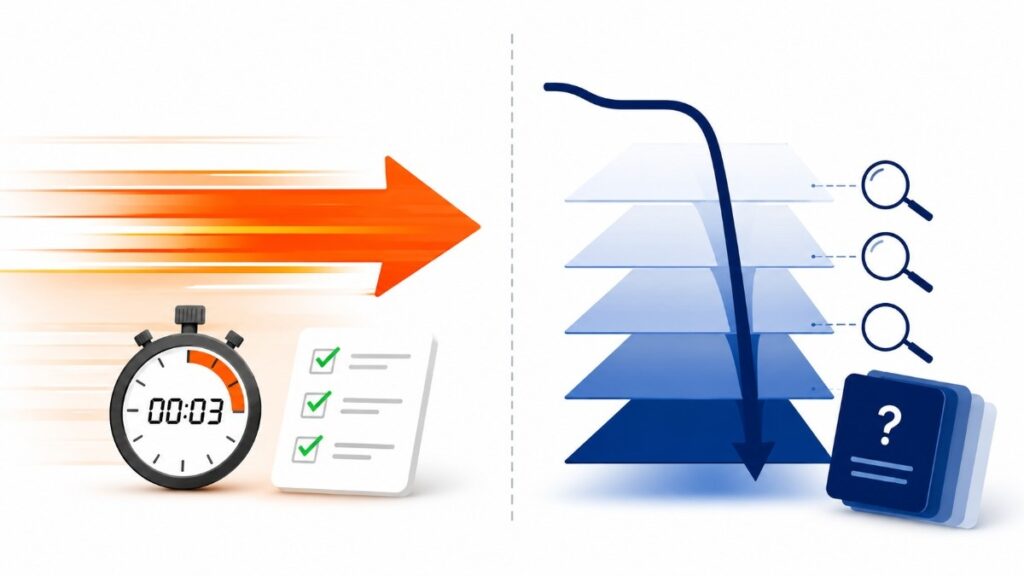
Speed vs Depth: The Trade-Off No Benchmark Captures
Here's the dynamic that actually matters when you use these models side by side.
Sol thinks like someone who needs an answer now. Describe a project, and within seconds you get structure, milestones, and next steps. It adapts smoothly to changes — "cut the timeline in half" — without restarting. The output is clean, actionable, and rarely needs a second attempt.
The flip side: sometimes the plan looks more complete than it is. For simple projects, that's fine. For complex projects with multiple moving parts, a missing dependency can cost you.
Claude Fable 5 thinks like someone who hates being wrong. It asks clarifying questions before committing. It surfaces dependencies you forgot. It presents alternatives instead of defaulting to the first answer. For high-stakes research, legal documents, or strategic decisions, this depth matters.
The trade-off: it takes twice as long. For everyday tasks, the extra caution feels like overkill.
Sonnet 5 thinks like someone who values precision over conversation. It says less, but what it says tends to be right. If you want a quick, reliable answer to a straightforward question, Sonnet 5 is the most cost-efficient option in this group. But it won't elaborate unless you push.
Gemini 3 Pro thinks like someone who read the entire internet. Its context window handles roughly 1.5 million words at once — entire books, full research collections, complete legal documents. It also understands images, video, and audio natively. But for focused text tasks, its output quality trails Sol and Fable 5.
I Gave Them the Same Tasks. Here's What Happened.
Rather than recite benchmark tables, here's what happened when these models faced four real-world tasks — the kind you actually do.
Writing a publishable blog post
The prompt:
Write a 2,000-word guide comparing the best AI tools for small business owners. Make it practical, warm, and easy to read — no jargon.
Sol produced a clean draft with solid structure and practical advice. Minor edits for voice, but the bones were there. It was fast — completed in one pass.
Fable 5's version had slightly more natural metaphors and warmer prose. It felt more human. But it took noticeably longer.
The takeaway: Sol for speed and volume. Fable 5 when voice is the product.
Researching a complex, nuanced topic
The prompt:
Analyze recent developments in renewable energy policy across the EU, US, and China. Compare approaches. Identify trends. Note any contradictions.
Sol delivered a clear comparison with labeled sections and covered the major trends. But it missed two regulatory nuances that would matter in a professional context.
Fable 5 caught both nuances, flagged three assumptions it was making, and presented multiple interpretations of conflicting data. It took longer, but left fewer blind spots.
The takeaway: Sol for quick summaries you'll verify. Fable 5 for research you'll cite.
Planning a product launch from scratch
The prompt:
I'm launching an online course in 6 weeks. Create a complete launch plan covering marketing, content, pricing, and timeline.
Sol delivered a structured 6-week plan with weekly milestones, task breakdowns, and realistic time estimates — immediately actionable.
Fable 5 asked seven questions before committing. The final plan was more thorough and caught risks Sol missed, but the back-and-forth took twice as long.
The takeaway: Sol when you need momentum. Fable 5 when missing a step is expensive.

Designing a landing page
The prompt:
Design a landing page for a meditation app. Modern, calming, with a hero section, feature highlights, testimonials, and a CTA.
This is the test that historically embarrassed GPT models. Sol didn't just pass — it matched Fable 5. Clean hierarchy, modern feel, good use of space. Fable 5 was very slightly more polished, but the difference was now a matter of taste, not quality.
The takeaway: The design gap is dead. Use either.
The pattern across all four tests
Sol and Fable 5 traded wins depending on the task. Neither dominated. The real insight: they're complementary. Sol is the speed model. Fable 5 is the accuracy model. Smart users switch between them.
The Design Gap Is Dead. Here's Why That Matters.
If you only remember one thing from this comparison, make it this.
For two years, GPT and Claude had a clear dividing line: you used Claude when design quality mattered, GPT when it didn't. GPT-4.o and GPT-5 consistently produced usable but uninspired visual output. Claude Fable models produced work that looked professionally designed.
GPT-5.6 Sol ends that division.
In independent testing across six real-world scenarios — building websites, creating 3D games, editing video, designing mobile apps — testers who historically preferred Claude for creative tasks called Sol's design output a tie with Fable 5. One tester noted that Sol's front-end designs were "indistinguishable from Fable 5's" in terms of visual quality.
This matters because most people don't want to manage two models. If Sol handles both writing and design at a high level, it becomes the obvious default for anyone whose work spans multiple formats.
The Money Question: What These Models Actually Cost You
| Model | Input (per 1M tokens) | Output (per 1M tokens) | Best for |
| GPT-5.6 Sol | $5.00 | $30.00 | Most everyday tasks |
| Claude Fable 5 | $10.00 | $50.00 | When quality justifies cost |
| Claude Sonnet 5 | $3.00 | $15.00 | Quick, reliable answers |
| Gemini 3 Pro* | $3.50 | $10.50 | Budget, large documents |
Gemini 3 Pro pricing based on available public information.
At first glance, Sol looks twice as cheap as Fable 5. But two things complicate the picture.
First, Sol has a long-context pricing trap. Once your input exceeds roughly 150-200 pages of text, the per-token price nearly doubles — bringing it close to Fable 5's cost. If you regularly feed large documents to your AI, the cost gap shrinks dramatically.
Second, cheaper per-response doesn't always mean cheaper per task. Some models need multiple attempts to get things right, burning through tokens with each retry. The real metric is "how much did completing this task cost?" not "what's the listed price?"
For most users doing most tasks, Sol offers the best value. For heavy users with large documents, do the math before committing.
The Other Two You Should Know About
Claude Sonnet 5 deserves more attention than it gets. At 3/3/15 per million tokens, it's the most affordable model in this group for text tasks. Its output is concise, accurate, and rarely wrong. It won't write you a masterpiece, but it will answer your question correctly on the first try.
Think of Sonnet 5 as the minimalist in the group. It says less, but what it says is right.
Gemini 3 Pro is the outlier. Its massive context window and native multimodal capabilities — it understands images, video, and audio directly — make it the Swiss Army knife. If your workflow involves processing enormous documents or working with visual media, Gemini fills a role the others can't.
But for pure text quality, it sits a tier below Sol and Fable 5. Use it for what it's uniquely good at, not as a default.
No Need to Choose: The Smart Way to Use AI Models
The teams getting the best results aren't loyal to one model. They route tasks based on what each model does best.
Here's a simple decision framework:
| If you're... | Start with... | Switch to... |
| Writing content | Sol | Fable 5 for voice-heavy pieces |
| Doing research | Fable 5 | Sol for quick summaries |
| Planning a project | Sol | Fable 5 for complex launches |
| Designing anything | Either | They're tied |
| Processing huge documents | Gemini | Sol for focused analysis |
| On a tight budget | Sonnet 5 | Sol when quality matters |
| Working with images/video | Gemini | — |
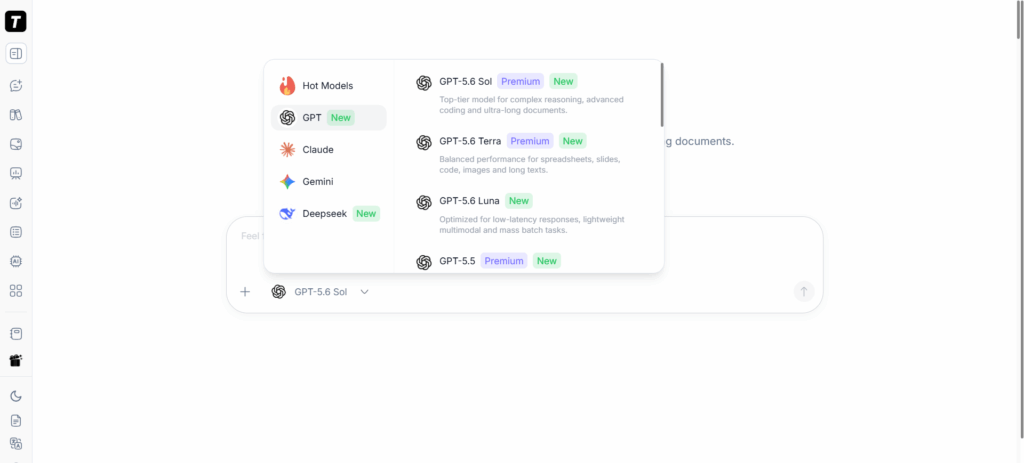
The whole point of TutorGPT is that you don't have to manage five different accounts to make this work. Access GPT-5.6 Sol, Claude Fable 5, Claude Sonnet 5, and Gemini 3 Pro in one place — no copying and pasting between windows, no juggling subscriptions, no mental overhead.
GPT-5.6 Sol FAQ
What is GPT-5.6 Sol?
GPT-5.6 Sol is OpenAI's newest flagship AI model, released in July 2026. It improves on previous GPT models with faster response times, better understanding of vague instructions, and significantly improved creative and design capabilities.
Is GPT-5.6 Sol better than Claude Fable 5?
It depends on the task. Sol is better for speed, writing, everyday tasks, and value for money. Fable 5 is better for deep research, complex analysis, and tasks where missing a detail is costly. They're complementary, not competitors.
How much does GPT-5.6 Sol cost?
Sol costs 5permilliontokensofinputand5permilliontokensofinputand30 per million tokens of output. For context, processing roughly 750 pages of text costs about 5ininput.Outputismoreexpensive—roughly5ininput.Outputismoreexpensive—roughly30 per 250 pages generated. Long documents (150+ pages) trigger a higher pricing tier.
Can GPT-5.6 Sol handle long documents?
Yes, up to about 700 pages of text in a single session. However, once your input exceeds roughly 150-200 pages, the pricing increases noticeably. For truly massive documents (1,000+ pages), Gemini 3 Pro's larger context window may be more practical.
What is GPT-5.6 Sol best at?
Sol excels at writing (fast, clean, publishable drafts), planning (structured, adaptable), creative work (now matching Claude for design), and everyday tasks where you want quick, useful answers without a long back-and-forth.
Who should use GPT-5.6 Sol?
Sol is ideal for writers, marketers, content creators, strategists, and everyday users who want one model that handles most tasks well. If you do deep research or high-stakes analysis regularly, pair Sol with Fable 5 for those specific sessions.
Conclusion
GPT-5.6 Sol is not a revolutionary leap. It's a practical one.
It doesn't dramatically outperform every competitor on every task. What it does is simpler and more useful: it closes the gaps that made previous GPT models feel incomplete.
The design gap? Closed. The speed gap? Widened. The "feels like talking to a robot" gap? Noticeably smaller.
For most people doing most tasks, Sol is the best single-model choice right now. It's fast, versatile, affordable, and rarely frustrating.
But the smartest users aren't picking one model. They're using Sol for daily work, Fable 5 when accuracy matters, Sonnet 5 for quick reliable answers, and Gemini for massive documents and visual tasks. The question isn't "should you switch?" It's "should Sol be your default?" And for most people, the answer is yes.