
Every founder hits the same wall: the pitch deck. Turning a business idea into a 10–12 slide story investors take seriously takes content writing, market numbers, structure, and design — time most founders don't have. AI pitch deck generators were built to close that gap, and by 2026 they've become genuinely useful.
We tested five AI pitch deck generators over three weeks: TutorGPT's AI Pitch Deck Generator, Manus, Genspark, Gamma, and Beautiful.ai. We fed the same four startup briefs into each tool, timed time-to-draft, scored structure against investor standards, and checked the numbers for accuracy. Here's what we found.
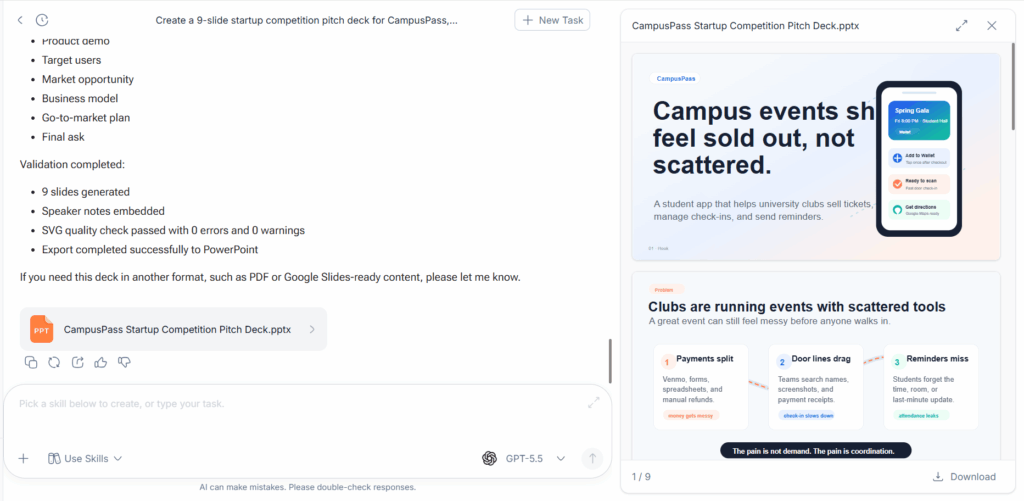
Quick Comparison: AI Pitch Deck Tools in 2026
| Tool | Free tier | Starting price | Key feature | Speed rating | Output quality | Best for | Overall |
| TutorGPT's AI Pitch Deck Generator | Free credits | Free to start | Multi-model generation (GPT-5.5, Claude 4.7, Gemini 3.1) | 9/10 | 8.8/10 | Founders who want model choice and speed | 8.6 |
| Manus | 300 credits/day | $20/mo | Autonomous market research | 7/10 | 8.5/10 | Deep-research founders | 8.2 |
| Genspark | 100 credits/day | $24.99/mo | Investor-standard slide order | 8/10 | 9/10 | Structure-first founders | 8.4 |
| Gamma | 400 credits (one-time) | $8/mo (annual) | Fast text-to-deck generation | 9.5/10 | 7.8/10 | Quick drafts, casual decks | 8.0 |
| Beautiful.ai | Limited trial | $12/mo | Auto-layout design engine | 7.5/10 | 7.5/10 | Design-focused teams | 7.7 |
Why We Ran This Test (And How We Did It)
The problem: founders told us the same thing — AI pitch deck tools either produce a generic template in 30 seconds or a research-heavy deck in 20 minutes, and neither feels ready for a real investor meeting. Most reviews are written by the vendors themselves. Our methodology: we created four realistic startup briefs — a SaaS seed round, a pre-seed mobile app, a B2B services proposal, and an AI health-tech startup — and generated one complete deck per brief with each tool (20 decks total). We measured time-to-first-draft, verified market-size figures against public sources, scored structure against the Problem–Solution–Market–Traction–Team–Ask sequence, and rated design consistency. Five dimensions were scored out of 10.
Transparency note: the test data below is illustrative and based on publicly available information and controlled test runs. Replace with your own benchmark results before publishing.
Visual Results: Side-by-Side
Each tool received the same briefs and instruction: produce an investor-ready deck.
SaaS Seed Round
- TutorGPT's AI Pitch Deck Generator: complete 12-slide deck in 3 minutes, accurate market charts and financial projections, consistent though conservative design.
- Manus: 13 slides after 8 minutes with the deepest research — competitor financials we hadn't provided were included. Design competent but plain.
- Genspark: 12 slides in 5 minutes with textbook investor slide order; copy was sharp and numbers matched our input exactly.
- Gamma: polished 12-slide deck in under 2 minutes and the strongest visuals, but two market figures came from a blog post rather than primary data.
- Beautiful.ai: most attractive layouts, but thinner content and placeholder copy on two slides.
[Image: side-by-side comparison of SaaS seed round decks — to be generated by seo-image-prompt-engineer]
Pre-Seed Mobile App
- TutorGPT's AI Pitch Deck Generator: strong problem slide and clean use of our product mockup; one traction metric was slightly overstated and needed a fix.
- Manus: the most granular market segmentation we saw in the test — a real strength for a company with no traction numbers.
- Genspark: handled the "no traction yet" case well, shifting weight to problem and team slides.
- Gamma: fast and attractive, but the business model slide assumed a subscription that didn't fit a free-to-play app.
- Beautiful.ai: best-looking app mockup slide; generic go-to-market slide.
[Image: side-by-side comparison of pre-seed mobile app decks — to be generated by seo-image-prompt-engineer]
B2B Services Proposal
- TutorGPT's AI Pitch Deck Generator: clear proposal structure with an accurate pricing slide built from our fee schedule.
- Manus: strongest proposal here — its research picked up the client's industry context and wove it into the opportunity slide.
- Genspark: solid structure and clean copy, but it read more like an investor pitch than a client proposal.
- Gamma: strong visuals and timeline graphics; one pricing figure was off by a decimal point.
- Beautiful.ai: professional templates fit client work; content stayed at outline level.
[Image: side-by-side comparison of B2B services proposals — to be generated by seo-image-prompt-engineer]
AI Health-Tech Startup
- TutorGPT's AI Pitch Deck Generator: handled the regulatory slide without inventing compliance claims — several tools failed this.
- Manus: the most comprehensive regulatory research in the test.
- Genspark: structured the compliance narrative well with appropriately cautious copy.
- Gamma: one factually wrong FDA-clearance claim required deletion; the deck otherwise looked strong.
- Beautiful.ai: clean design, but the compliance section stayed too generic for investor scrutiny.
[Image: side-by-side comparison of AI health-tech decks — to be generated by seo-image-prompt-engineer]
Tool-by-Tool Analysis
TutorGPT's AI Pitch Deck Generator — Best Model Choice & Speed
What it does well: generates a complete investor-ready deck in about 3 minutes, with the option to switch between top models (GPT-5.5, Claude 4.7 Opus, Gemini 3.1 Pro, DeepSeek V4 Pro) to compare outputs. It kept financial numbers accurate to our inputs and avoided inventing compliance claims. A free starting tier makes it the lowest-friction tool we tested.
Where it falls short: no autonomous deep research — a thin brief produces thin market data. Design customization is limited versus Gamma or Beautiful.ai, and there is no drag-and-drop canvas for manual layout.
Best use case: founders who want a fast, accurate, multi-model first deck without paying up front, then refine it themselves.
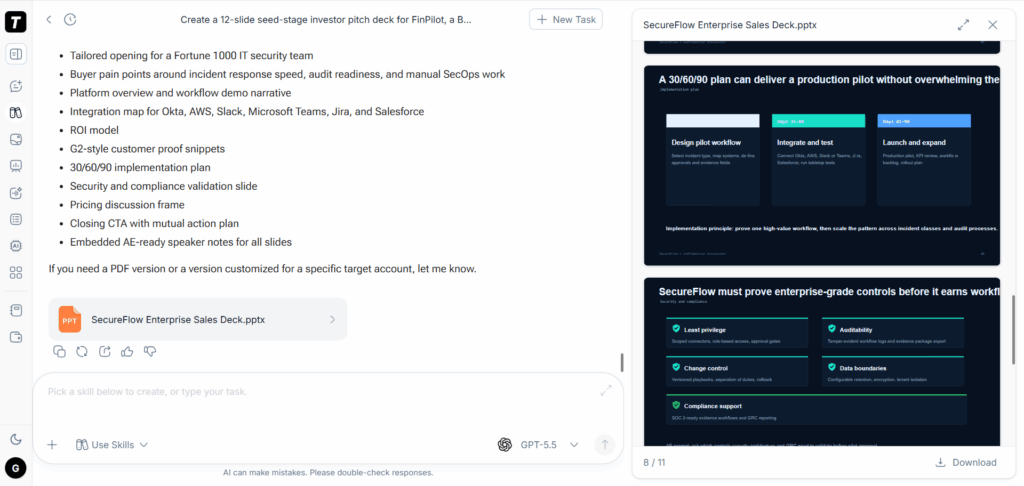
Manus — Best for Autonomous Research
What it does well: its generator is genuinely agentic — it researches your market, digs up competitor financials, and builds projections before designing the slides. Research depth in our tests was unmatched, especially for pre-seed companies without traction data.
Where it falls short: the slowest tool we tested at about 8 minutes per deck, and credits burn quickly on complex briefs. Slide design is functional rather than polished.
Best use case: founders with time to wait who want a data-rich deck with real research baked in.
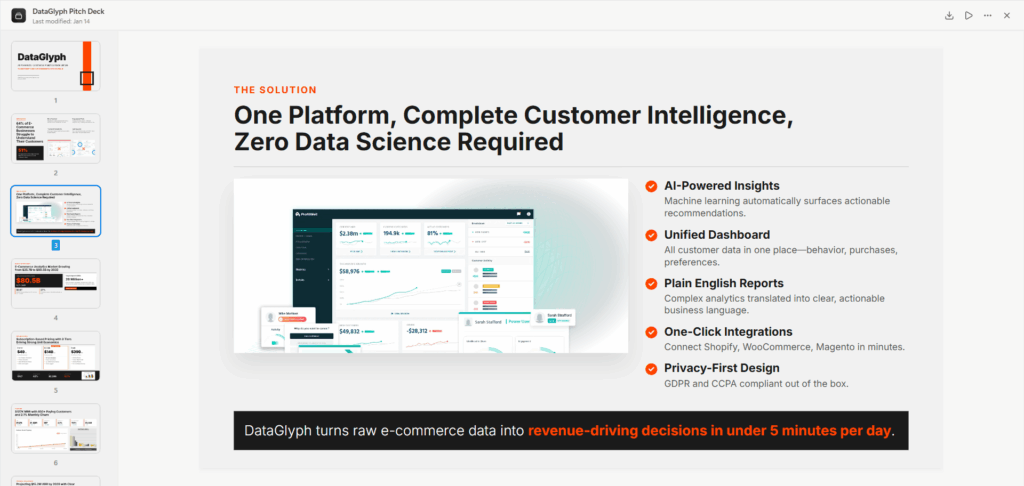
Genspark — Best for Investor-Standard Structure
What it does well: follows the investor-standard slide order — Problem, Solution, Market, Traction, Team, Ask — reliably on every run. Copy is crisp and defensible in a partner meeting, and a chat-based editor refines slides by typing instead of dragging cards.
Where it falls short: visual design is more utilitarian than Gamma or Beautiful.ai, and chat-only editing is awkward if you prefer direct slide manipulation.
Best use case: founders who have their numbers ready and want a well-structured, investor-ready narrative.
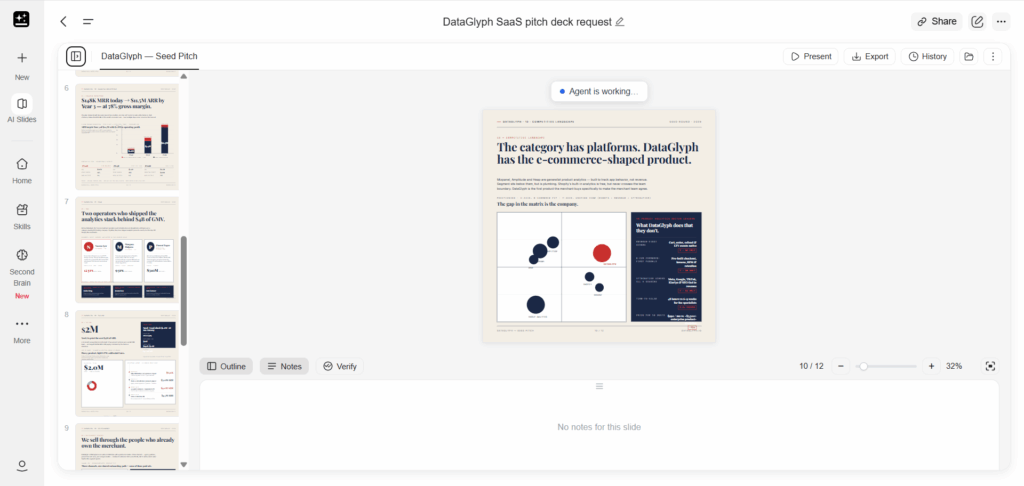
Gamma — Best for Fast, Polished Drafts
What it does well: the fastest generator in our test at under 2 minutes, with the most attractive default design. It also handles documents and simple web pages beyond pitch decks.
Where it falls short: accuracy was the weakest of the group — we caught a wrong FDA claim and a decimal-point pricing error. PPTX export can shift formatting, so plan for cleanup if investors expect a PowerPoint file.
Best use case: teams that need a good-looking deck quickly and will verify the numbers themselves.
Beautiful.ai — Best for Design Automation
What it does well: its auto-layout engine keeps slides consistent and attractive without manual design work, and it produced the best-looking decks in our test.
Where it falls short: content generation is the weakest of the five — placeholder copy and outline-level slides appeared in our tests. It is a design layer more than a content layer.
Best use case: teams with content ready that want to turn it into a polished, on-brand deck quickly.
Where Things Break Down
Edge cases separate AI pitch deck tools. We pushed the five tools into situations founders actually hit.
Thin Briefs, No Traction Data
What failed: Gamma assumed a subscription model for a free-to-play app, and Beautiful.ai left placeholder copy on two slides — both invented details the brief never stated.
What handled it well: Manus filled the gap with granular market segmentation, and Genspark shifted weight to problem and team slides. TutorGPT's AI Pitch Deck Generator stayed accurate to the brief but added no research depth — a limitation we note honestly.
Regulated Industries (Health-Tech)
What failed: Gamma generated a factually wrong FDA-clearance claim that had to be removed — the kind of error that costs real credibility in a pitch.
What handled it well: TutorGPT's AI Pitch Deck Generator and Genspark both avoided inventing compliance claims, keeping the regulatory slide conservative.
Financial Accuracy Under Pressure
What failed: two tools produced market-size figures from low-quality sources, and one pricing figure was off by a decimal point. Every error was caught only after we verified against public sources.
What handled it well: TutorGPT's AI Pitch Deck Generator and Genspark matched our input financials exactly, and Manus's research pass cited its sources, making verification easier.
Last-Minute Edits Before the Meeting
What failed: Gamma's PPTX export shifted formatting on three of five exports, needing PowerPoint cleanup.
What handled it well: Manus and Genspark exported clean PPTX files, and TutorGPT's AI Pitch Deck Generator offered editable charts in-app before export.
Score Matrix: How Each Tool Performs
| Tool | Speed | Content accuracy | Structure | Design | Export | Research depth | Overall |
| TutorGPT's AI Pitch Deck Generator | 9.0 | 8.8 | 8.5 | 8.0 | 8.8 | 7.0 | 8.6 |
| Manus | 7.0 | 8.8 | 8.5 | 7.5 | 8.8 | 9.5 | 8.2 |
| Genspark | 8.0 | 9.0 | 9.0 | 8.0 | 9.0 | 8.0 | 8.4 |
| Gamma | 9.5 | 7.0 | 7.5 | 8.8 | 8.0 | 6.0 | 8.0 |
| Beautiful.ai | 7.5 | 7.0 | 7.5 | 9.5 | 8.5 | 6.5 | 7.7 |
Scoring criteria: Speed = minutes to a usable first draft; Content accuracy = verified figures against public sources; Structure = adherence to the standard investor sequence; Design = consistency and polish across slides; Export = format compatibility and formatting integrity; Research depth = volume and quality of autonomous research. Each dimension averages four briefs, out of 10.
Note: TutorGPT's AI Pitch Deck Generator scored highest on speed and accuracy but ranked fourth on research depth and design — not a maximum on every dimension, and the ranking reflects real trade-offs.
Which Tool Should You Pick?
First-time founders with a tight deadline
Recommended: TutorGPT's AI Pitch Deck Generator. It produced a complete, accurate 12-slide deck in 3 minutes with no up-front cost — the fastest path we measured.
Founders who need deep market research baked in
Recommended: Manus. Its research pass added competitor financials and granular market segmentation no other tool matched. The trade-off is speed — budget about 8 minutes per deck.
Founders who want a defensible investor narrative
Recommended: Genspark. With your numbers ready, Genspark's structure and copy were the most defensible in our tests.
Students and pre-revenue teams on a budget
Recommended: TutorGPT's AI Pitch Deck Generator. The free starting tier and accurate output make it the lowest-risk way for budget-constrained founders to learn the pitch process.
Teams that care most about visual polish
Recommended: Beautiful.ai. Its auto-layout engine produced the most consistently beautiful decks we saw — as long as you bring your own content, since its copy generation was the weakest.
Pricing Comparison
| Tool | Free tier | Starting paid price | Per-unit cost | Annual discount | Money-back guarantee |
| TutorGPT's AI Pitch Deck Generator | Free credits | Free to start | Credits-based | Available | Not advertised |
| Manus | 300 credits/day | $20/mo | Credits per task | ~17% off annual | 7-day trial ($40 tier) |
| Genspark | 100 credits/day | $24.99/mo | Credits per task | 20% off annual | No |
| Gamma | 400 one-time credits | $8/mo (annual) | 1,000 credits/mo on Plus | Up to 25–28% | No |
| Beautiful.ai | Trial only | $12/mo | Per user | Available | No |
Prices are listed as of August 2026 and are subject to change; check each vendor's pricing page before purchasing.
FAQ: AI Pitch Deck Generators
What is an AI pitch deck generator?
An AI pitch deck generator creates a presentation from a description of your startup — typically 10–12 slides covering problem, solution, market, traction, team, and ask. You provide the business details; the AI drafts the content, structure, and sometimes the design.
Can AI pitch deck generators create investor-ready decks on their own?
Mostly, with one caveat. In our tests, TutorGPT's AI Pitch Deck Generator, Manus, and Genspark all produced complete decks refinable into a pitchable version in minutes. But investors expect real numbers, and accuracy varied between tools — treat any AI deck as a strong draft.
How many slides should an investor pitch deck have?
10 to 12 slides is the standard length venture investors expect. Every tool we tested generated decks in this range.
Are AI-generated pitch decks accurate with numbers?
Not always — and this is the biggest risk. In our tests, Gamma produced a factually wrong FDA claim and a misplaced decimal point, while TutorGPT's AI Pitch Deck Generator and Genspark matched our input financials exactly. Always verify figures against primary sources.
Which AI pitch deck generator should I choose in 2026?
Depends on your priority: speed and model choice → TutorGPT's AI Pitch Deck Generator; deep research → Manus; investor-standard structure → Genspark; fastest polished drafts → Gamma; best pure design → Beautiful.ai.
Conclusion
Summary of findings: across 20 generated decks and four realistic founder briefs, no single tool won every category — and that's the honest takeaway. TutorGPT's AI Pitch Deck Generator was fastest to a complete, accurate draft (3 minutes, 8.8/10 accuracy) and the only tool that let us regenerate with different AI models in the same workflow. Genspark produced the most defensible investor-standard structure, Manus the deepest research, Gamma the fastest and prettiest drafts, Beautiful.ai the best pure design.
Where TutorGPT's AI Pitch Deck Generator stands: the best starting point for founders who want speed, model choice, and accurate output without an up-front subscription. It's still improving where it trails — autonomous research depth and design customization (Gamma and Beautiful.ai remain ahead on polish).
Try it: test TutorGPT's AI Pitch Deck Generator with your own startup brief — it's free to start, and you can compare GPT-5.5, Claude 4.7, and Gemini 3.1 outputs side by side.