
Competitor research rarely begins with a tidy brief. More often, a founder wants to know why another product is winning, a sales rep needs a battlecard before tomorrow's call, or a product marketer realizes a rival changed its pricing weeks ago. Someone opens twelve tabs, copies screenshots into a spreadsheet, asks an AI chatbot for a summary, and promises to update everything next month.
Next month arrives. The spreadsheet is already stale.
That gap between a one-time report and a repeatable workflow is where AI Competitor Analysis Tools are most useful. Some collect and structure public information. Others watch specific pages, track search visibility, estimate traffic, or push competitive guidance into live sales deals. They are not interchangeable, even when their homepages use similar language.
We compared ten leading options by the work they remove from a real competitor analysis workflow, the evidence they can access, and what happens after the first report is finished.
The Best AI Competitor Analysis Tools at a Glance
| Tool | Best fit in the workflow | Starting price* |
| TutorGPT | Turning competitor names or URLs into a structured first report | Free tier |
| Klue | Connecting market intelligence to B2B sales deals | Custom |
| Visualping | Catching changes on pricing, product, and messaging pages | Free; paid from about $10/month annually |
| Semrush | Researching SEO, PPC, keywords, and search competitors | About $139/month |
| Ahrefs | Finding backlink, keyword, and content gaps | Starter access from about $29/month |
| Similarweb | Estimating traffic, channels, and market position | Free access; paid from about $199/month |
| Competely | Creating repeatable competitor profiles with monitoring | From about $39/month |
| Sprout Social | Comparing social content, engagement, and audience growth | About $199/user/month annually |
| BuzzSumo | Understanding competitor content and amplification | About $199/month annually |
| SpyFu | Reviewing SEO and PPC history on a smaller budget | About $39/month |
- Prices and plan limits change. Confirm them on the provider's website before purchasing.
For a fast, general competitor report, TutorGPT is the most accessible starting point. Klue suits mature B2B sales organizations, while Visualping handles the “tell me when this page changes” part of the job. Semrush and Ahrefs go much deeper into search, Similarweb adds directional traffic data, and Sprout Social covers the social layer.
Why the Workflow Matters More Than the Biggest Feature List
The slowest part of competitor research is often collection, not analysis. A marketer can spend an afternoon moving ad creative, pricing details, review snippets, and feature claims into a document before any useful comparison begins. When several clients or product lines are involved, the work expands quickly.
The second problem appears after collection. A page-change alert says that 47 lines changed, but not whether the competitor launched a new tier or merely adjusted its footer. A dashboard shows estimated traffic without explaining what the team should do. An AI summary sounds convincing, yet one invented feature makes the rest difficult to trust.
Then comes distribution. Product marketing produces a polished battlecard, saves it in a shared drive, and learns three months later that sales representatives never opened it. The research existed; it simply arrived in the wrong place and at the wrong moment.
Good competitor research software solves one or more of these workflow failures. The best choice is not the platform with the most tabs. It is the one that removes the bottleneck your team experiences every week.
10 Best AI Competitor Analysis Tools
1. TutorGPT: Best for a Fast, Structured First Report
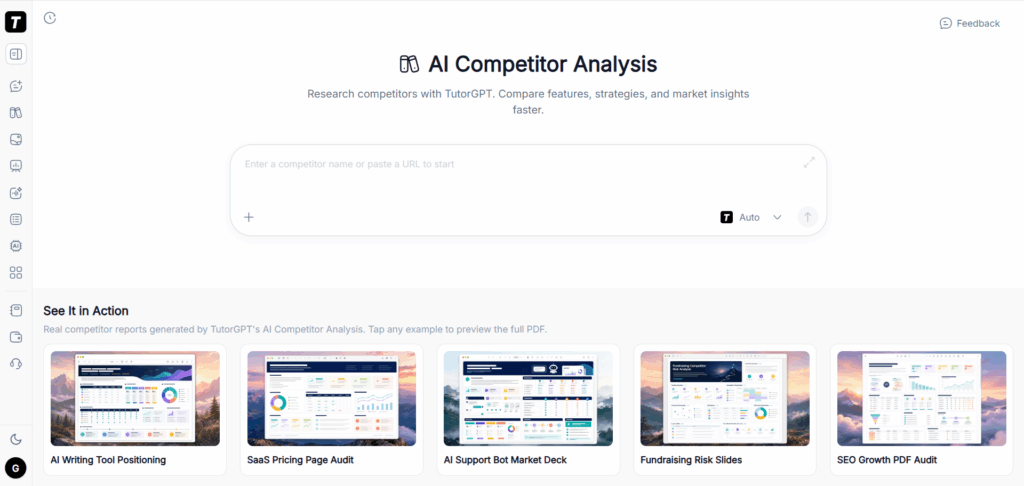
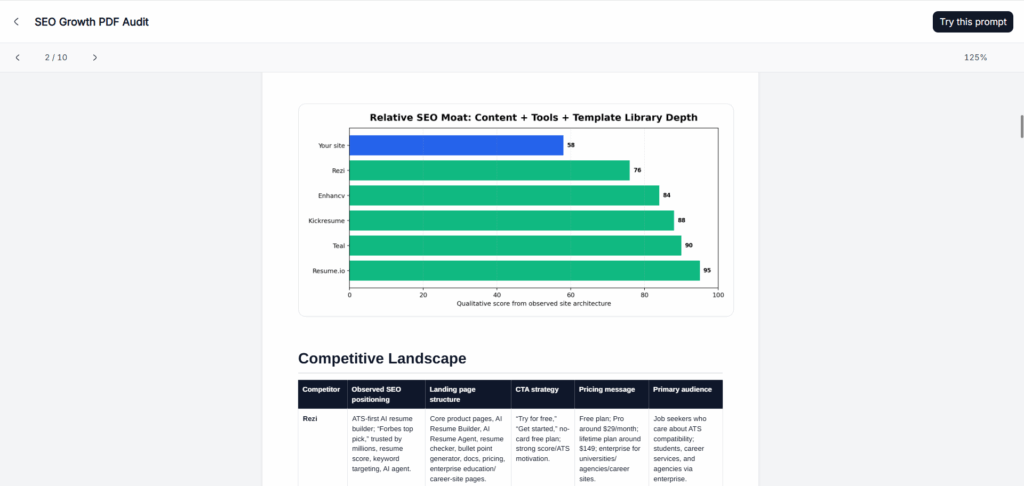
TutorGPT AI Competitor Analysis is built for the moment when you have several competitor names and need a usable overview without assembling the research by hand. It compares public information about products, features, pricing, positioning, reviews, gaps, and opportunities, then organizes the findings into a report or battlecard.
TutorGPT is strongest at breadth and speed. It will not replace years of backlink history from Ahrefs or internal win-loss data from Klue. Instead, it provides the common research layer many teams currently build through scattered searches and inconsistent prompts. Among general-purpose options, it is a practical place to begin.
2. Klue: Best When Competitive Intel Must Reach Sales
Klue addresses a later stage of the workflow. A mature B2B company may already have website research, CRM notes, call recordings, buyer interviews, and win-loss feedback. Its problem is turning that volume into guidance a seller can use during an active deal.
The platform brings those signals together, supports continuously updated battlecards, and distributes relevant intelligence through systems such as Salesforce, HubSpot, Gong, Slack, and Microsoft Teams. Klue is less of a quick research utility and more of a competitive enablement program.
For a five-person startup, the setup and custom pricing may be unnecessary. For a sales organization repeatedly facing the same rivals, delivering the right objection handling at the moment of need can be far more valuable than generating another market report.
3. Visualping: Best for the Pages You Cannot Afford to Miss
Imagine discovering during a customer call that a competitor introduced a free plan two weeks earlier. That is not an analysis problem; it is a monitoring problem.
Visualping watches selected webpage sections and sends an alert when something changes. Teams commonly point it at pricing tables, feature pages, homepages, documentation, release notes, terms pages, and job listings. Its AI filters routine edits and explains the meaningful difference in ordinary language.
False or trivial alerts can still occur, so careful page selection and custom instructions matter. Visualping cannot explain search performance or social sentiment, but it pairs naturally with broader AI Competitor Analysis Tools that create the baseline report.
4. Semrush: Best for a Search-Led Competitor Workflow
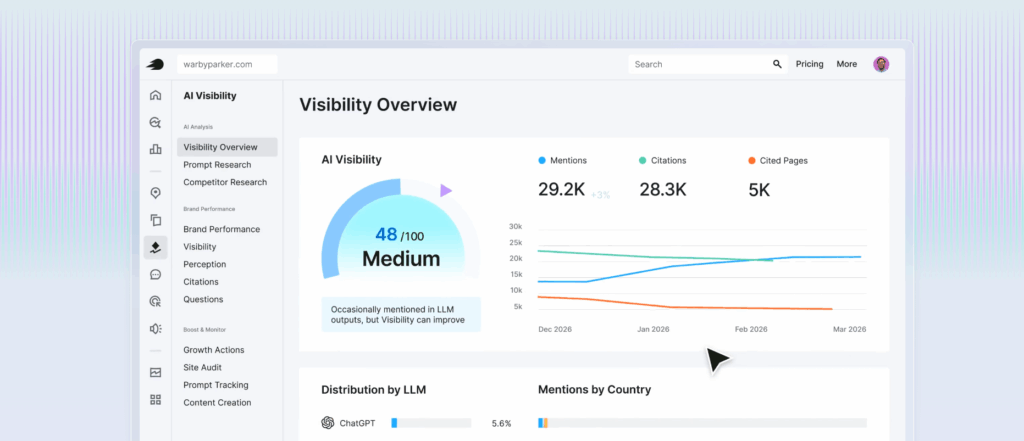
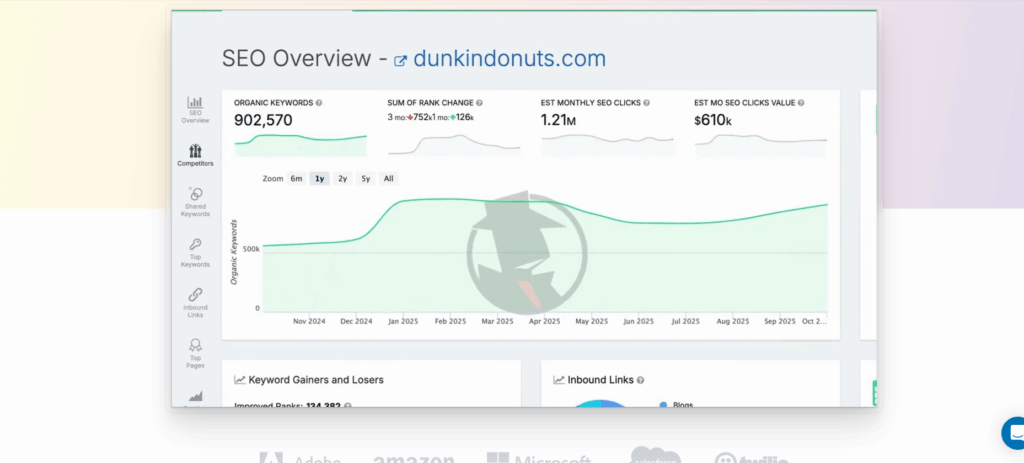
When “competitor” means the domains taking your clicks on Google, Semrush is usually more relevant than a product comparison tool. It can reveal ranking keywords, paid search activity, backlink gaps, top-performing pages, estimated traffic, and content opportunities.
Its breadth helps agencies that need SEO, PPC, content, and reporting in one environment. The tradeoff is complexity; a founder comparing three pricing pages can easily pay for machinery they will not use.
Semrush works best after the question becomes specific: Which commercial keywords do rivals rank for? Where are they buying traffic? Which pages appear to drive organic growth? Used this way, the platform supplies evidence that a general AI summary cannot safely invent.
5. Ahrefs: Best for Backlinks and Content Gaps
Ahrefs earns its place through the depth of its search and backlink data. It shows which competitor pages attract links, the terms those pages rank for, and where your own content coverage is thin. Content Gap and Site Explorer can turn a vague request to “do what our competitors do” into a shortlist of observable opportunities.
SEO teams often prefer Ahrefs when links and organic content are central. Credits and usage limits require attention during larger projects. Product packaging, sales objections, and customer sentiment still need other inputs.
6. Similarweb: Best for Directional Traffic Intelligence
Competitors do not share their analytics. Similarweb fills part of that blind spot with estimates for website traffic, acquisition channels, engagement, audience geography, and relative market position.
The word “estimates” is important. Data for large sites can reveal meaningful direction: one rival depends heavily on paid traffic, another appears strong in direct visits, and a third is gaining referrals. Small or niche domains may not provide enough observable activity for reliable precision.
Similarweb is better for comparing scale and movement than declaring an exact visitor count. An early-stage company with a few thousand monthly visits may find that manual customer and positioning research tells a clearer story.
7. Competely: Best for Repeatable Profiles and Monitoring
Competely sits between an improvised AI chat and an enterprise competitive intelligence platform. It builds structured profiles around positioning, pricing, audiences, features, strengths, weaknesses, and SWOT findings, while retaining sources and monitoring competitor changes over time.
Its channel data is not as deep as specialist platforms for SEO, traffic, or social media. For a small team that values a repeatable overview more than a massive proprietary dataset, that compromise may be reasonable.
8. Sprout Social: Best for Social-First Brands
A competitor's website shows what the company wants to say. Social channels reveal how often it speaks, what earns engagement, how the audience reacts, and whether momentum is shifting.
Sprout Social compares publishing frequency, audience growth, engagement, and content performance across major networks. Its listening capabilities extend the view to mentions and sentiment, which is useful for consumer brands and agencies managing active communities.
Pricing is per user and rises quickly. If social media plays a supporting role, the competitive features may not justify the cost. For social-first brands, the same data can influence campaigns every week.
9. BuzzSumo: Best for Content and Amplification Research
BuzzSumo answers a focused question: which competitor content travels furthest, and who helps it spread? Marketers can examine high-performing topics, links, engagement, journalists, and influencers instead of judging a content strategy by publication volume alone.
It is a specialized investment. Teams that rarely run content or PR campaigns will get more from another category of competitive analysis software. For publishers, agencies, and content-led brands, the amplification data can reveal opportunities that a standard competitor profile misses.
10. SpyFu: Best for Affordable SEO and PPC History
SpyFu offers a narrower, lower-cost route into search competitor research. It tracks organic keywords, paid terms, ranking history, and historical ad copy, allowing marketers to see how a rival's search strategy developed rather than viewing only the latest snapshot.
Its boundary is also clear: search is only one part of the market. Pair it with a structured competitor report when product, pricing, reviews, and positioning matter too.
Choosing AI Competitor Analysis Tools Around Your Actual Week
Start with the recurring task that drains time. If Monday mornings disappear into checking pricing and feature pages, choose a page monitor. If every new campaign begins with five hours of copying competitor information, use a structured research tool. If sellers keep asking the same questions in Slack, a battlecard and distribution platform may be the better investment.
Finally, test whether the output survives outside the dashboard. A useful result might be a pricing-change alert routed to Slack, a two-page product comparison for a roadmap meeting, or a deal-specific counterpoint inside the CRM. If the team still has to translate everything into another document, the workflow remains unfinished.
For many small teams, the sensible stack begins with TutorGPT for the baseline, a monitoring tool for the few pages that matter, and one specialist platform for the dominant acquisition channel. More software should be added only when a repeated decision requires it.
Can ChatGPT Replace AI Competitor Analysis Tools?
ChatGPT can summarize pages, compare documents, cluster review complaints, and draft a SWOT analysis once clean evidence has been collected.
The trouble begins when a general chatbot is treated as the database. It may blend current search results with older knowledge, present an inference as a fact, or invent a missing feature with complete confidence. It also stops working when the conversation ends; nothing checks the pricing page next Tuesday.
Use a chatbot for flexible reasoning and writing. Choose purpose-built AI Competitor Analysis Tools when the job requires repeatable collection, proprietary datasets, consistent comparisons, monitoring, or delivery into team workflows.
Frequently Asked Questions
What are the best AI Competitor Analysis Tools?
TutorGPT is well suited to fast structured reports, Visualping to website monitoring, Semrush and Ahrefs to search research, Similarweb to traffic estimates, Sprout Social to social analysis, and Klue to enterprise sales enablement. The best option depends on the evidence and decision your workflow requires.
Are there free AI Competitor Analysis Tools?
TutorGPT offers free competitor scans, while Visualping provides a limited number of free page checks. Several search and traffic platforms also provide restricted free access or trials. Free plans are usually enough to test whether the output is useful before committing to a subscription.
How accurate is AI competitor analysis?
Accuracy depends on source quality and freshness. Current first-party pages are strongest for product and pricing facts; reviews and community discussions are better for identifying perceptions and recurring problems. Important claims should always be checked before they influence pricing, positioning, or a sales response.
How often should competitor analysis be updated?
Fast-moving software and ecommerce markets may require continuous alerts and a monthly review. Many B2B teams can run a deeper quarterly analysis. Pricing changes, major launches, new packaging, acquisitions, and messaging shifts should trigger an immediate update.
What should a competitor analysis workflow produce?
The result should support a real decision. Depending on the team, that may be a sales battlecard, a feature-gap discussion, a pricing response, a content opportunity, or a message to test. A long report that nobody revisits is not a successful workflow.
Final Verdict
There is no universal winner because competitor analysis is not one activity. TutorGPT is the strongest starting point for a fast, accessible report. Klue is designed for competitive B2B sales organizations. Visualping watches live pages, Semrush and Ahrefs investigate search, Similarweb estimates traffic, Sprout Social reads social performance, BuzzSumo follows content amplification, and SpyFu provides affordable search history.
The most useful choice is often smaller than expected. A solo product marketer monitoring ten URLs does not need enterprise infrastructure; a global sales team should not rely on a spreadsheet and monthly reminder. Match the platform to the moment where information is late, scattered, or ignored.
If that moment is the first research pass, try TutorGPT's free AI Competitor Analysis tool. Add the competitors, review the structured comparison, and use the result as the living baseline for the rest of the workflow.